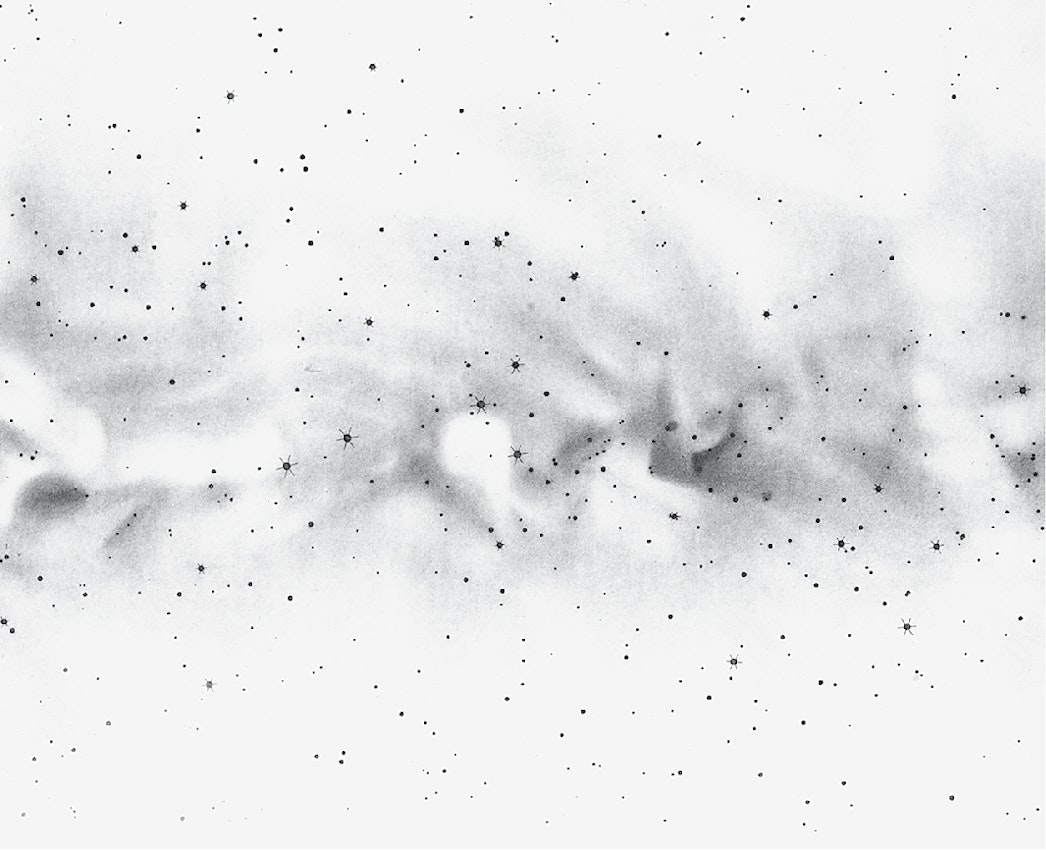
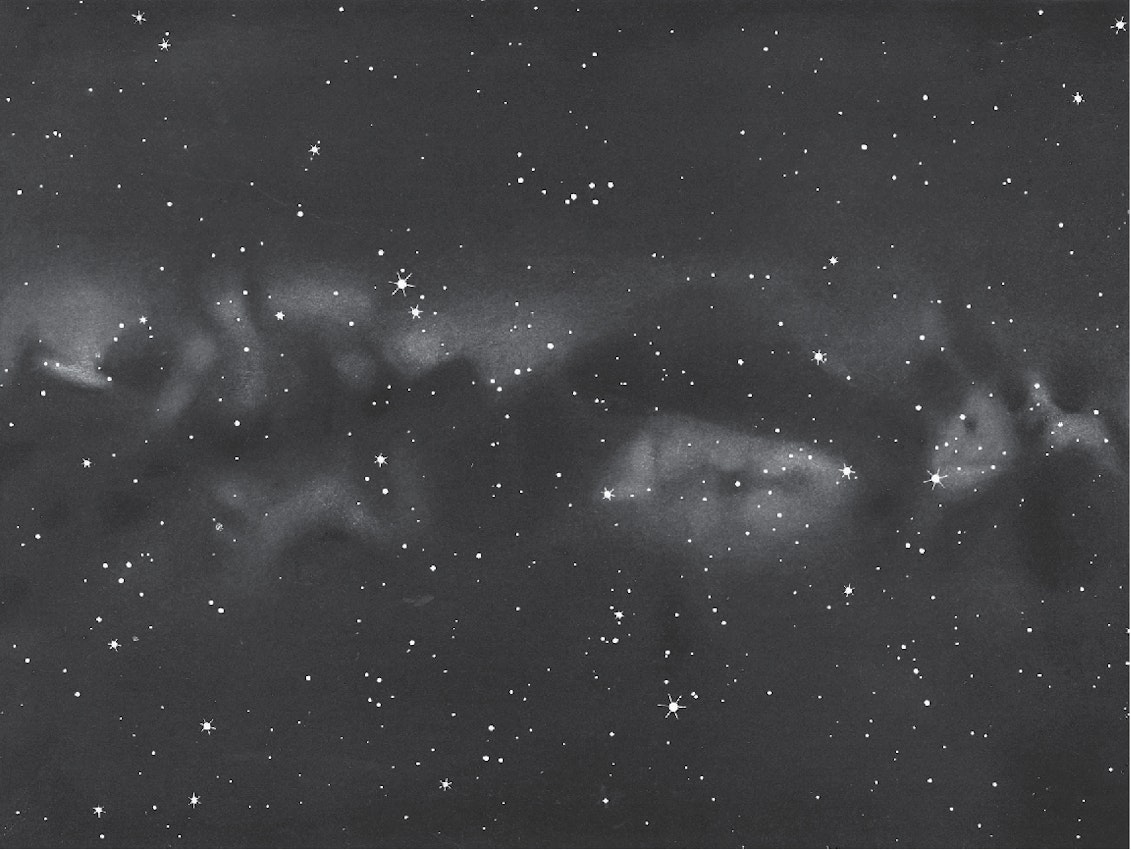

In the many drawings that Dutch astronomer, Marxist thinker, and council communist Antonie (“Anton”) Pannekoek (1873–1960) made of the Milky Way over the course of his life, it is not immediately clear what we are looking at. The band of stars appears like a smudged backbone, sometimes in “true” colour (white stars on a black background), and sometimes inverted, with the stars as dark points and the “milk” of the Milky Way made inky.
Pannekoek went further, theorising that what we perceive as the Milky Way is actually a visual trick that emerges at the intersection of the stars and the people on earth who perceive them. During an article published in an 1897 issue of Popular Astronomy, Pannekoek discussed the well-known problem of the Milky Way’s ocular inconsistency, wondering if “the character of the galactic phenomenon precludes its being fixed by delineation”.
This was not just a failing of observational science; it reflected what the Milky Way actually was:a kind of optical illusion that changed its shape depending on the lived experiences of the observer, their historical period, and how these experiences informed the patterns that the mind constructed out of the fluid nature of reality.
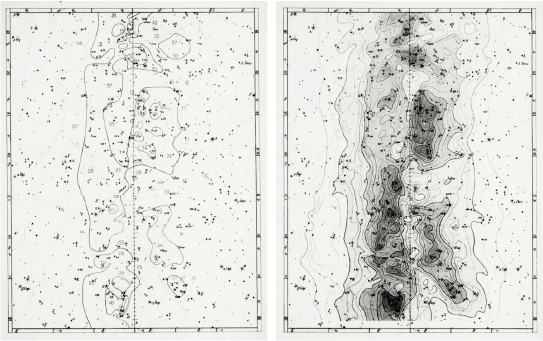
From today’s perspective, there is something deeply alien about Pannekoek’s inverse maps of the Milky Way. The shadow at once carefully contoured and vague, like the marks a crumpled bedsheet might leave on morning skin. These images address themselves towards something that is inevitably elusive — an “average” of various human and mechanical visions — and yet they do so with intense care and rigour.
Working at a time when all industries were increasingly mechanised, Pannekoek did not necessarily champion the replacement of written accounts with machine-based methods of perception, but instead sought some form of collective subjectivity by bringing together different “organic” and mechanical ways of seeing. If much of the history of post-Enlightenment techno-science can be explained as the quest to mechanise vision in order to increase its precision and accuracy, then Pannekoek was moving in the opposite direction, distorting the camera’s gaze in order to bring it into closer proximity with human sight.
A dialectical view of the night sky opens up a path beyond any absolute binary between truth and falsity, evoking a form of scientific rigour and precision that does not aim to present itself as complete or incontestable. Pannekoek’s drawings therefore hark back to an earlier form of astronomy which, as Charlotte Bigg writes, embraced a “qualitative, literary and aesthetic approach rather than a quantitative, mathematical approach to phenomena”.20 By foregrounding interpretive variety, Pannekoek edges towards a more bottom-up and decentralised way of doing science; one that has the potential to complement anti-colonial and anti-capitalist methodologies.

It was their quality as aesthetic objects that first captured my interest in Pannekoek’s
sketches, and I’d guess that this is also what has helped these sketches to endure.
The aesthetic realm, for Pannekoek, was a manifestation of the
way in which the human mind is able to
build order out of the disorder
of the cosmos
As Johan Hartle writes: “This idea of a profound isomorphism between cosmic order, nature,
human society, and even the individual subject. . . held the promise of a society based on a
self-regulating system of material forces”.21